
Speed-to-lead is now one of the most decisive performance factors in the moving industry. As customers submit multiple quote requests at once, the first response often determines who wins the booking, not just who offers the lowest price. This dataset examines how lead response time directly affects conversion rates for residential and commercial moving leads across the U.S. and Canada in 2026.
Speed-to-Lead Benchmarks in the Moving Industry
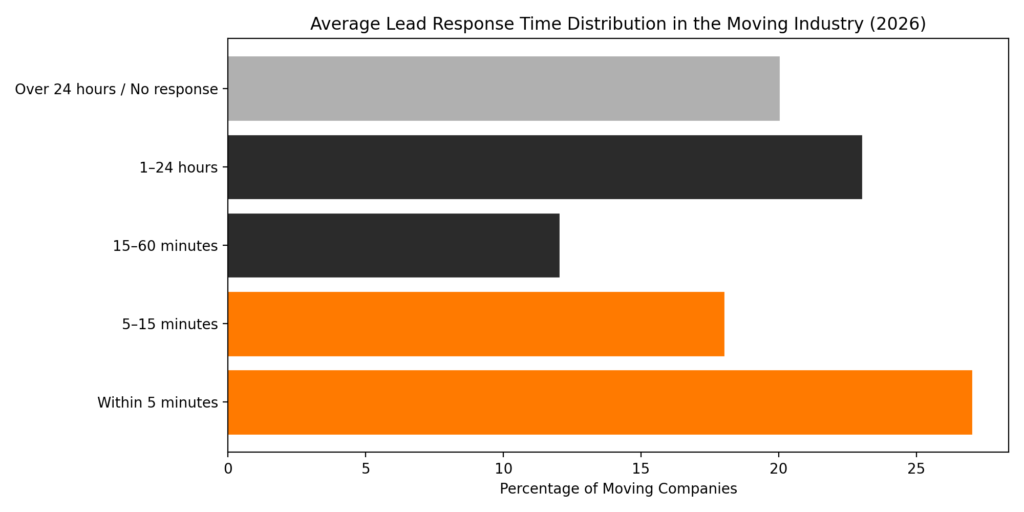
Lead response speed is a measurable competitive advantage for moving companies, not a soft sales tactic. With consumers requesting multiple quotes within minutes, even short delays significantly reduce the chance of making first contact. These benchmarks show how quickly moving leads are actually being contacted across the U.S. and Canada, and how that compares to buyer expectations.
Key speed-to-lead benchmarks (2026):
- The average first response time for service-based businesses remains over 40 hours, despite growing customer expectations for near-instant replies.
- Only about one-quarter of moving companies respond to new leads within 5 minutes, the window most strongly associated with successful contact and qualification.
- Nearly half of all moving leads are still contacted after 24 hours or not at all, effectively removing them from realistic conversion potential.
- More than 50% of consumers now expect a response from a moving company within one hour, with expectations even higher for online form submissions.
- Speed gaps are consistent across both residential and commercial leads, indicating that response delays are operational rather than lead-type driven.
Lead Conversion Rates by Response Time
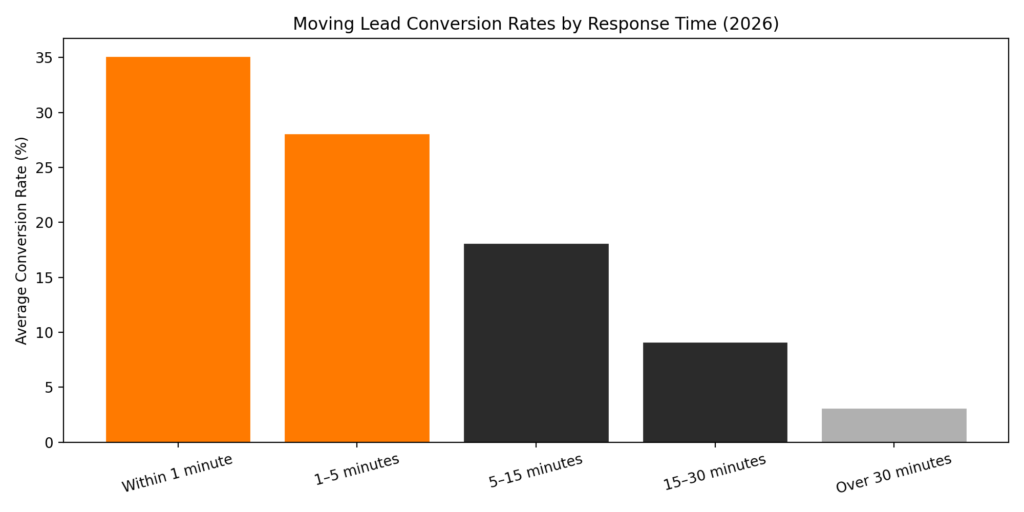
In 2026, response time is one of the strongest predictors of lead conversion in the moving industry. As buyers compare multiple quotes simultaneously, even minor delays sharply reduce engagement and the likelihood of booking. These benchmarks show how conversion rates decline as response time increases for residential and commercial moving leads across the U.S. and Canada.
Key conversion benchmarks by response time (2026):
- Moving leads contacted within 5 minutes are over 20 times more likely to convert than those contacted after 30 minutes, making this window the most critical for sales teams.
- Responding within the first minute can increase lead-to-booking conversion rates by nearly 4× compared to delayed outreach.
- Leads contacted between 5 and 15 minutes still perform strongly but show a noticeable drop in conversion compared to near-instant responses.
- Once response time exceeds 30 minutes, conversion rates fall sharply, and many leads become unreachable or are already booked by competitors.
- Leads first contacted after 24 hours show minimal conversion potential, regardless of price competitiveness or follow-up effort.
First-Contact Timing and Booking Probability
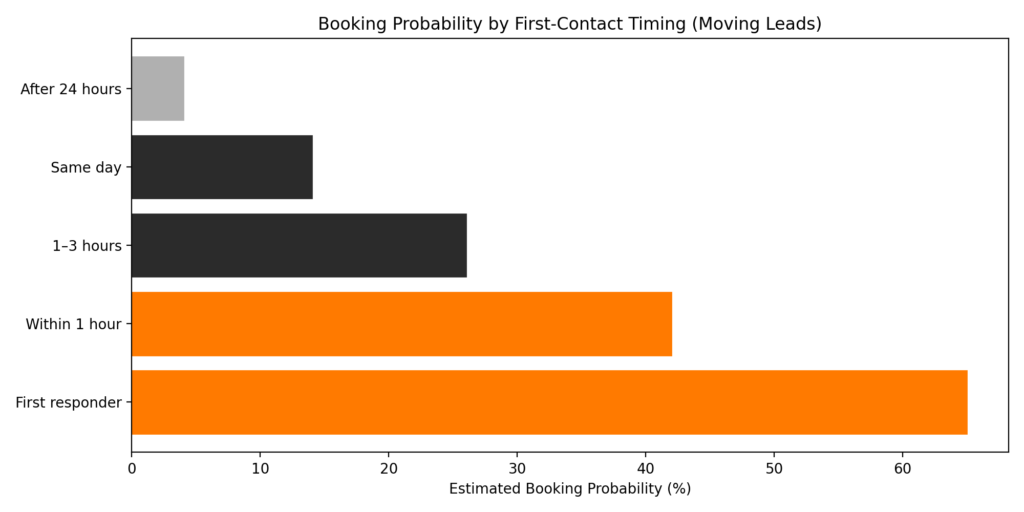
The timing of the first live contact plays a decisive role in whether a moving lead turns into a booked job. In competitive quote environments, customers typically engage with the first company that responds and are far less likely to continue evaluating options once a conversation has started. These benchmarks illustrate how booking probability varies with when first contact occurs, rather than with price or follow-up volume alone.
Key first-contact benchmarks:
- A majority of moving customers ultimately book with the first company that responds, giving early responders a clear structural advantage.
- Leads contacted within the first hour are several times more likely to progress to an estimate or booking compared to those contacted later the same day.
- Once first contact is delayed beyond a few hours, the likelihood of meaningful engagement declines sharply as customers commit elsewhere or disengage entirely.
- Leads first contacted after 24 hours show consistently low booking rates, even after follow-up attempts.
- This first-contact advantage applies across both residential and commercial leads, indicating that response order matters more than move size or complexity.
Phone vs Form Lead Response Performance
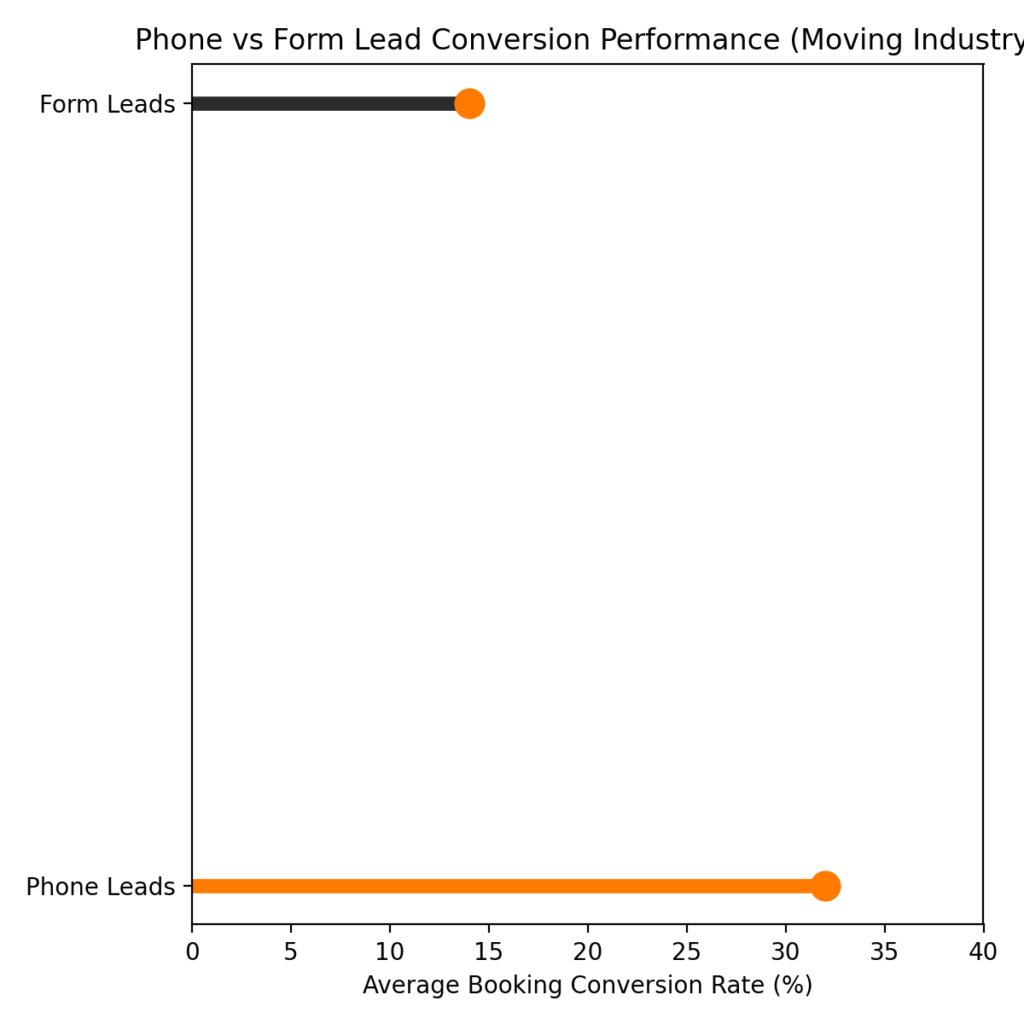
Not all moving leads behave the same once contact is made. Phone-based inquiries and online form submissions differ significantly in urgency, intent, and conversion behavior. Understanding these differences helps explain why response speed and contact method directly influence booking outcomes across both residential and commercial moves.
Key performance differences between phone and form leads:
- Phone leads consistently show higher booking rates than form submissions, as callers tend to have stronger intent and shorter decision timelines.
- Leads reached through a live phone conversation typically progress faster through the sales process, often requiring fewer follow-up attempts before a booking decision is made.
- Form leads represent a larger share of total inquiries but are more sensitive to response delays, with conversion rates dropping sharply if contact is not made quickly.
- Moving companies that convert form leads into phone conversations early see significantly better outcomes than those relying solely on email follow-up.
- These performance patterns remain consistent across local, long-distance, residential, and commercial leads, indicating that contact method plays a structural role in conversion behavior.
Follow-Up Speed and Conversion Lift
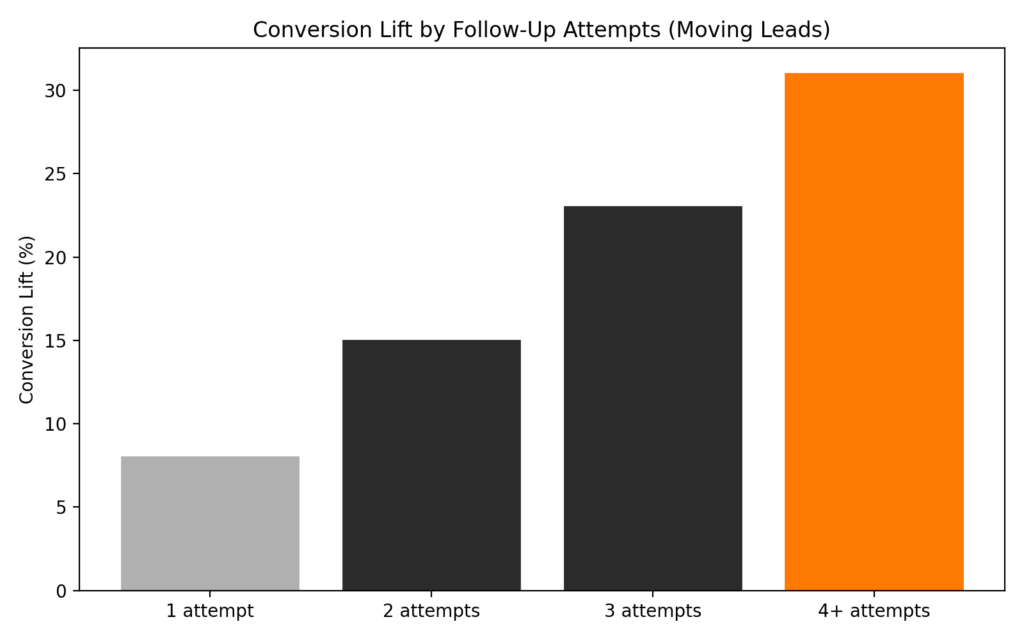
Initial response speed matters, but follow-up execution often determines whether a moving lead ultimately converts. Many prospects do not book on the first interaction and require additional contact before making a decision. These benchmarks show how follow-up timing and persistence influence conversion outcomes, especially for form-based and price-sensitive leads.
Key follow-up performance benchmarks:
- A large share of converted moving leads requires multiple contact attempts, with many bookings occurring only after the second or third follow-up.
- Leads who receive same-day follow-up after the initial contact show significantly higher engagement than those contacted days later.
- Conversion rates increase when follow-ups are made within hours, rather than waiting until the next business day.
- Combining phone calls with text or email follow-ups improves response rates compared to single-channel outreach.
- Moving companies that stop follow-up after one attempt consistently underperform those with a structured, time-based follow-up cadence.
Average Lead-to-Customer Conversion Rates
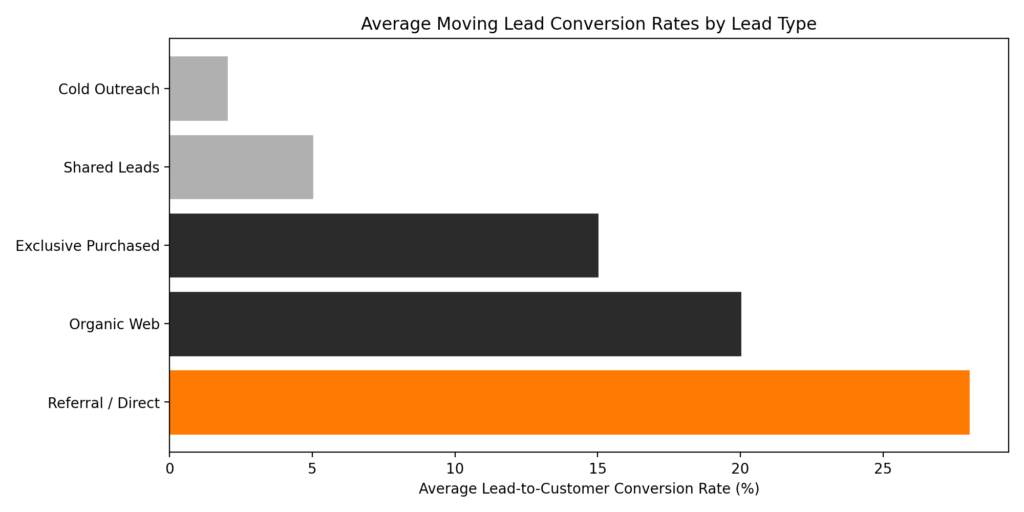
While response speed and follow-up execution influence outcomes, baseline lead-to-customer conversion rates provide essential context for evaluating overall sales performance. Across the moving industry, only a portion of incoming leads ultimately result in booked jobs, with outcomes varying based on lead quality, urgency, and engagement timing.
Key conversion rate benchmarks:
- On average, only a small percentage of total moving leads convert into booked moves, reflecting the competitive and comparison-driven nature of the market.
- Residential moving leads generally convert at higher rates than commercial inquiries, mainly because decision cycles are shorter and fewer stakeholders are involved.
- Commercial leads tend to have more extended evaluation periods and lower close rates, but often result in higher-value bookings when converted.
- Leads that originate from direct inquiries or referrals consistently outperform cold or shared leads in overall conversion.
- Moving companies that maintain consistent response and follow-up processes typically outperform industry averages, even when working with mixed lead quality.
Sales Funnel Drop-Off Rates for Moving Leads
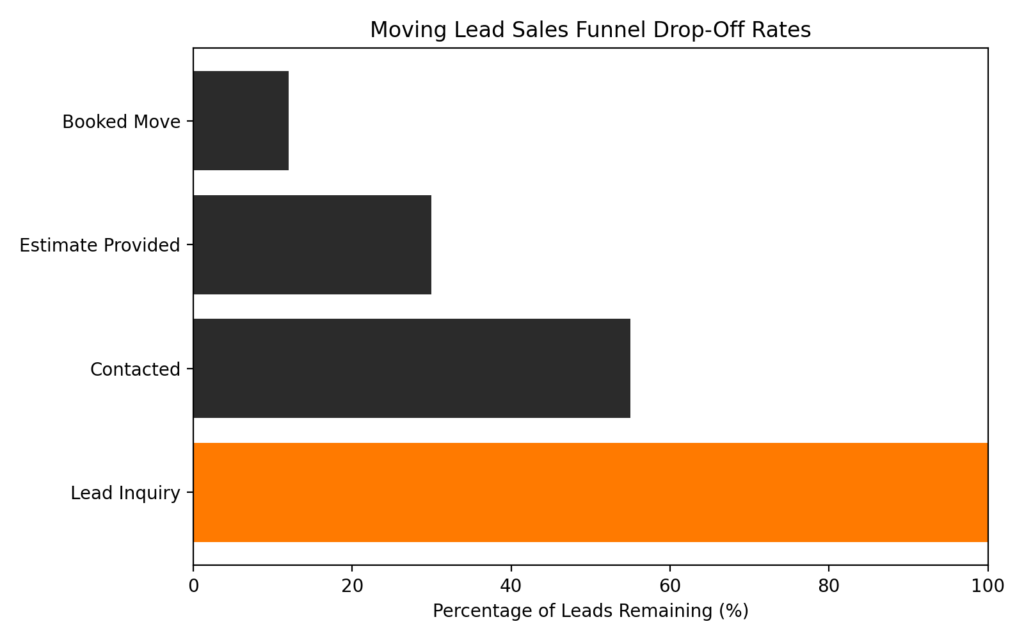
Most moving leads do not fail at the pricing stage but drop out earlier in the sales funnel, often before meaningful contact is made. Understanding where leads are lost provides critical context for response-time and follow-up benchmarks. This section outlines how leads typically progress from inquiry to booking and where the greatest attrition occurs.
Key funnel drop-off benchmarks:
- A significant portion of moving leads never result in direct contact, often due to delayed response times or limited follow-up capacity.
- Among leads that are successfully contacted, only a subset proceed to receive a formal estimate or quote.
- The most significant single drop-off typically occurs between initial inquiry and first live conversation, highlighting the importance of speed-to-lead.
- Additional attrition occurs after estimates are delivered, as customers compare options or delay decisions.
- Moving companies with structured response workflows and follow-up schedules retain a higher percentage of leads through each funnel stage.
Key Takeaways for Moving Companies
Across the moving industry, response speed and execution discipline consistently shape lead outcomes more than pricing or lead volume alone. The benchmarks in this dataset show that most performance gaps emerge early in the sales process, often before a quote is ever delivered.
Moving companies that respond quickly, establish early contact, and maintain structured follow-up retain a larger share of inbound demand through each funnel stage. In contrast, delayed outreach and inconsistent follow-up account for a significant portion of lost opportunities, regardless of lead type or market.
Taken together, these findings reinforce a simple operational reality: speed-to-lead is not a tactic but a system-level capability. Companies that treat response time as a core metric are better positioned to convert demand efficiently and sustainably.