
Not all moving leads are created equal. Some sources drive bookings at scale, while others burn through budgets with minimal returns. This 2025 dataset reveals how today’s top-performing lead providers stack up in terms of cost, conversion, and ROI, so moving companies can make data-backed decisions before investing another dollar.
Top U.S. Moving Lead Sources Compared by ROI
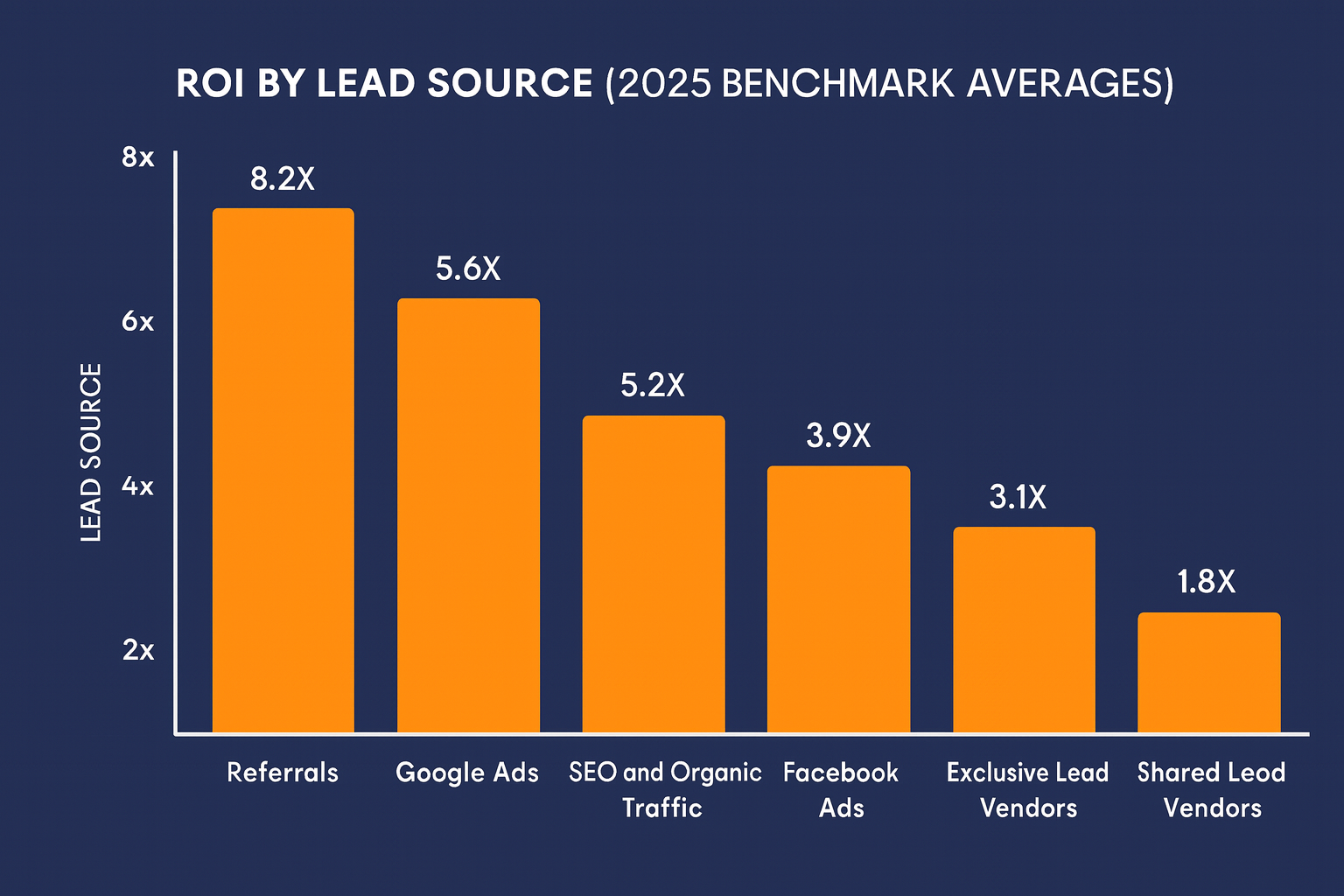
Not all lead sources deliver the same return. In 2025, organic web leads and referrals continue to outperform others, while shared leads from third-party vendors show the weakest ROI due to competition, stale data, and refund issues.
ROI by Lead Source (2025 Benchmark Averages)
| Lead Source | Avg ROI (Return on Ad Spend) | Notes |
|---|---|---|
| Referrals | 8.2x | Highest ROI from trusted customer introductions |
| Google Ads | 5.6x | Strong intent but requires hands-on optimization |
| SEO and Organic Traffic | 5.2x | Lower CPL with steady long-term return |
| Facebook Ads | 3.9x | Lower CPL but weaker buyer intent |
| Exclusive Lead Vendors | 3.1x | Moderate ROI when targeting local moves |
| Shared Lead Vendors | 1.8x | Lowest ROI due to competition and lead fatigue |
Conversion Rates by Lead Source
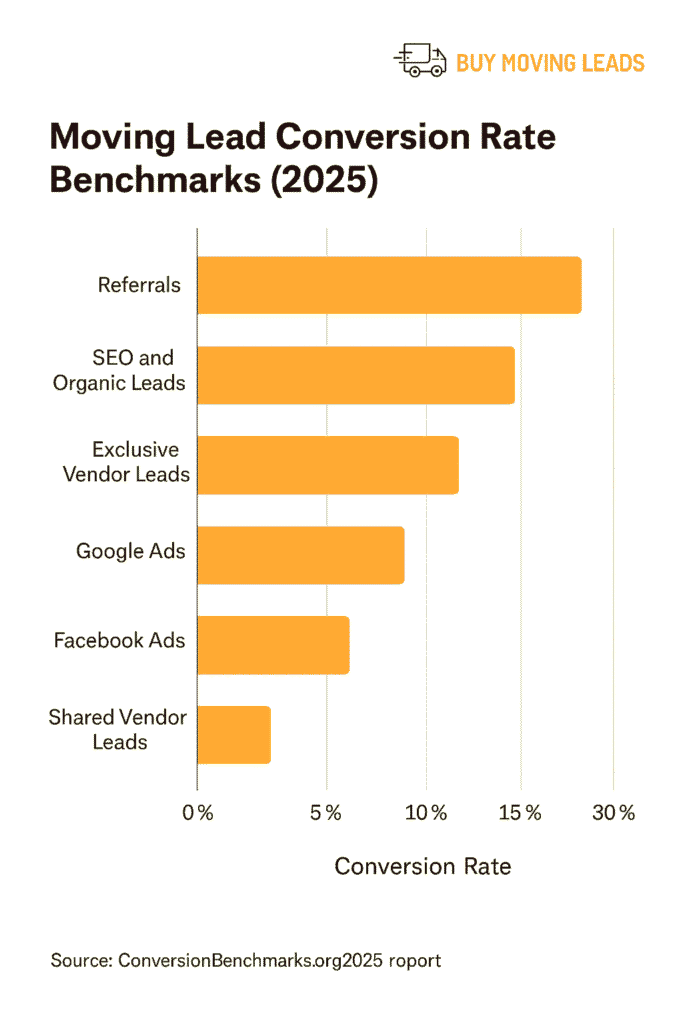
Conversion rates vary widely depending on the source. Exclusive leads and organic traffic tend to convert at higher rates due to direct intent and lower competition, while shared and cold leads perform the weakest, often due to saturation or a lack of qualification.
Moving Lead Conversion Rate Benchmarks (2025)
| Lead Source | Average Conversion Rate | Notes |
|---|---|---|
| Referrals | 26 to 33 percent | Warmest leads, high buyer intent |
| SEO and Organic Leads | 18 to 22 percent | Intent-driven but depends on the landing page and timing |
| Exclusive Vendor Leads | 14 to 17 percent | Effective for local moves when contact is immediate |
| Google Ads | 10 to 15 percent | Intent-driven, but depends on the landing page and timing |
| Facebook Ads | 6 to 10 percent | Cheaper clicks, lower urgency leads |
| Shared Vendor Leads | 3 to 6 percent | Lowest conversion due to multiple buyers contacting |
| Cold Email or SMS Leads | 1 to 3 percent | Passive, low-converting channels |
Cost Per Lead (CPL) Benchmarks
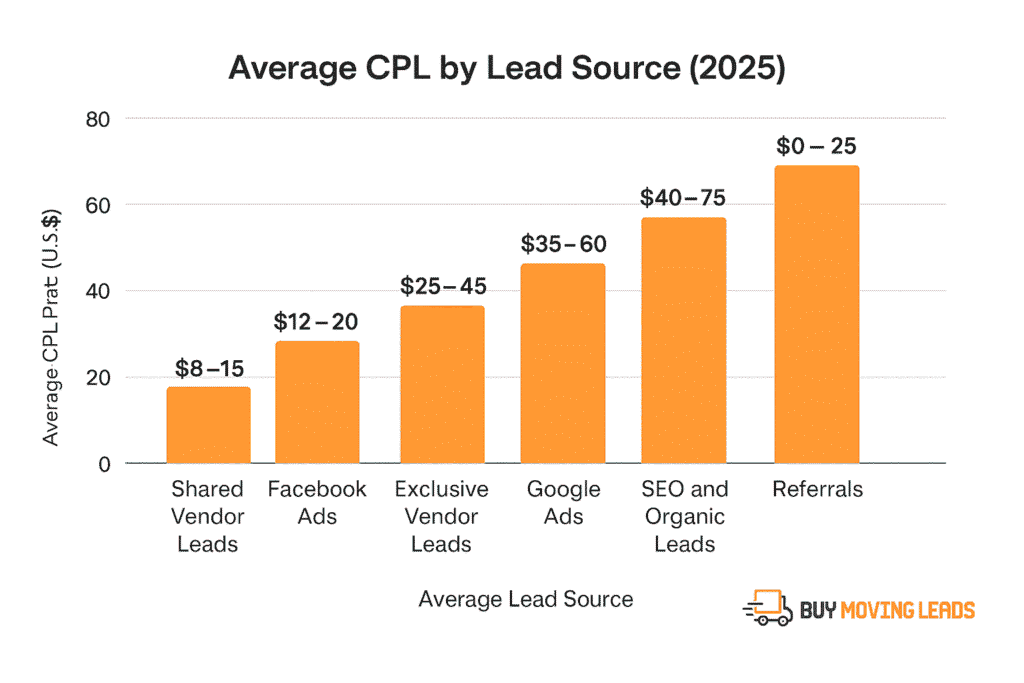
Cost per lead varies based on lead exclusivity, delivery method, and marketing channel. In 2025, shared leads remain the most affordable to purchase, but they often come with lower conversion rates and higher refund rates. Exclusive and inbound leads cost more but deliver stronger results when paired with a fast response.
Average CPL by Lead Source (2025)
| Lead Source | Average CPL (USD) | Notes |
|---|---|---|
| Shared Vendor Leads | 8 to 15 | Cheapest, often resold to multiple buyers |
| Facebook Ads | 12 to 20 | Relatively low cost per click but needs strong targeting |
| Exclusive Vendor Leads | 25 to 45 | More qualified, especially for local service areas |
| Google Ads | 35 to 60 | Higher intent but expensive in competitive regions |
| SEO and Organic Leads | 40 to 75 | Lower ongoing CPL after upfront content investment |
| Referrals | 0 to 25 | Usually free or low-cost through existing relationships |
Cost Per Booked Move (CPBM) Benchmarks
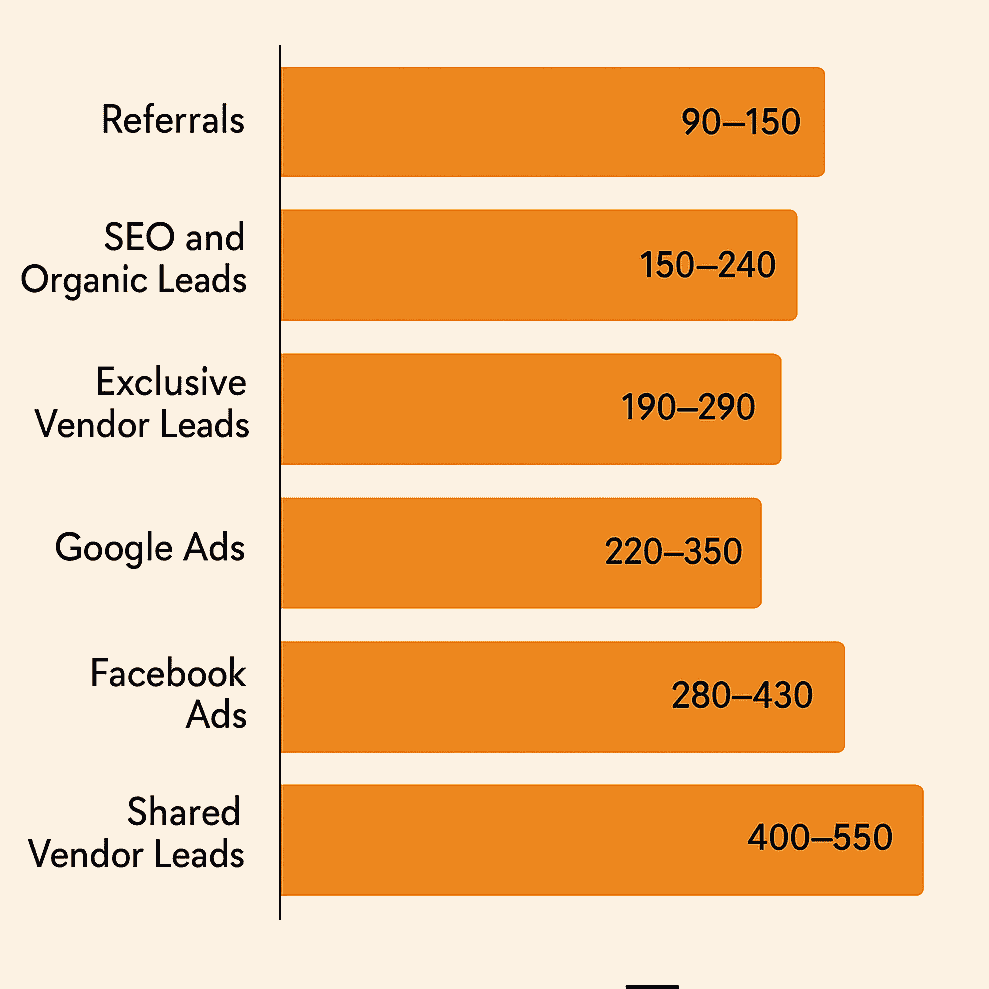
While cost per lead is an important metric, CPBM provides a clearer picture of return by factoring in conversion rates. In 2025, organic and referral-based leads maintain the lowest CPBM, while shared leads and paid traffic with lower intent cost significantly more to convert into booked jobs.
Average CPBM by Lead Source (2025)
| Lead Source | Average CPBM (USD) | Notes |
|---|---|---|
| Referrals | 90 to 150 | Lowest CPBM due to strong trust and intent |
| SEO and Organic Leads | 150 to 240 | Scalable, especially for long-distance or recurring moves |
| Exclusive Vendor Leads | 190 to 290 | Can perform well when coupled with fast response |
| Google Ads | 220 to 350 | Higher cost offset by stronger buyer intent |
| Facebook Ads | 280 to 430 | Mid-funnel leads require nurturing |
| Shared Vendor Leads | 400 to 550 | Can perform well when coupled with a fast response |
Refund Rates by Lead Source
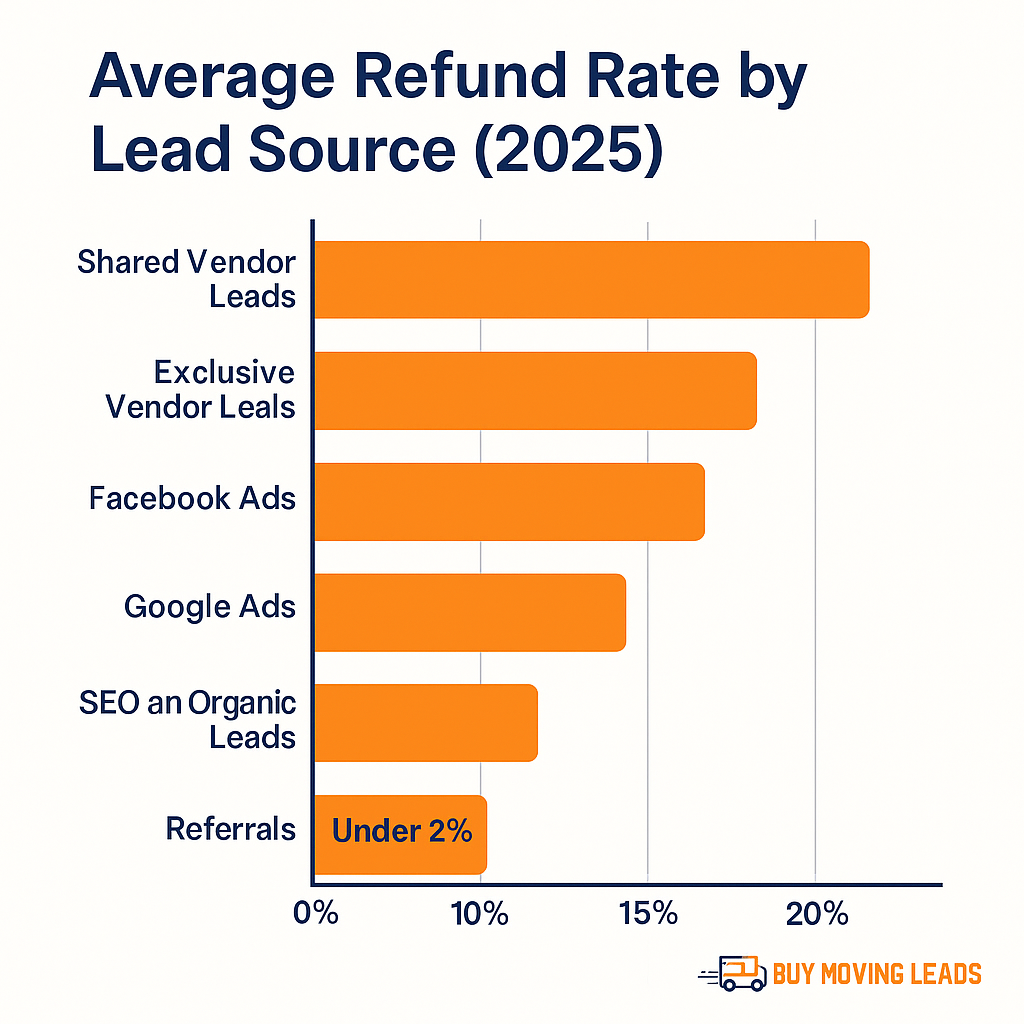
Refund rates are a crucial indicator of lead quality. High refund volumes often stem from duplicate data, invalid contacts, or misleading filters. In 2025, shared lead vendors remain the most problematic, while organic and referral-based leads have virtually no refund activity.
Average Refund Rate by Lead Source (2025)
| Lead Source | Refund Rate Range | Common Refund Reasons |
|---|---|---|
| Shared Vendor Leads | 18 to 25 percent | Duplicates, disconnected numbers, already booked |
| Exclusive Vendor Leads | 10 to 15 percent | Poor filtering, non-local delivery |
| Facebook Ads | 8 to 12 percent | Fake accounts, lead form bots |
| Google Ads | 5 to 9 percent | Wrong move type, non-serviceable zip codes |
| SEO and Organic Leads | 1 to 4 percent | Minimal, mostly form mis-submissions |
| Referrals | Under 2 percent | Highly qualified, direct intent |
According to the Federal Trade Commission, misleading advertising and consumer lead resale practices continue to be ongoing concerns in the home services industry (FTC.gov).
Lead Quality and Validity Benchmarks
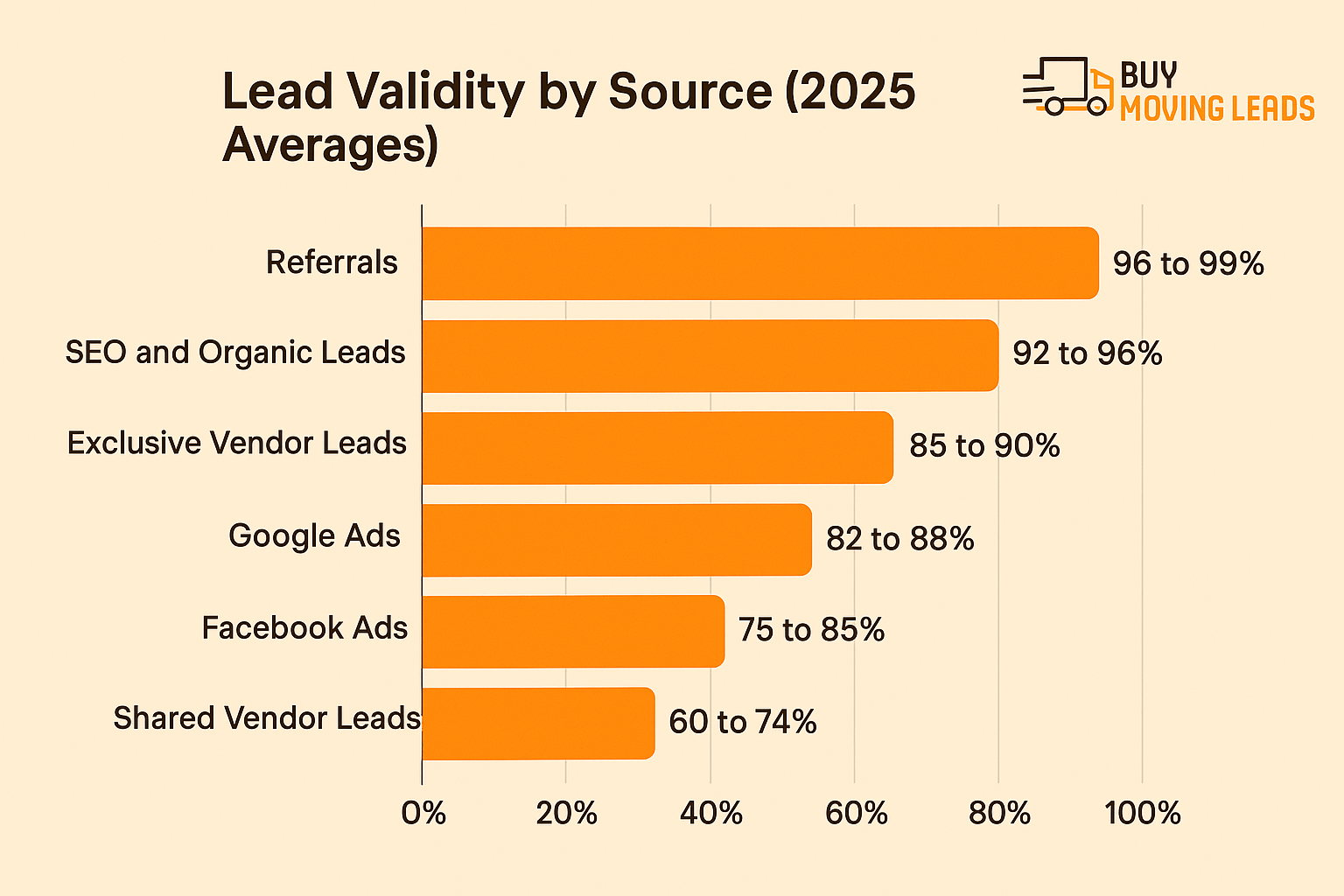
Lead quality plays a critical role in campaign ROI. The percentage of valid, contactable, and serviceable leads varies significantly across sources. In 2025, referrals and organic leads continue to produce the cleanest, most actionable data, while shared and cold-sourced leads often suffer from high bounce and invalidity rates.
Lead Validity by Source (2025 Averages)
| Lead Source | Validity Rate | Common Invalid Issues |
|---|---|---|
| Referrals | 96 to 99 percent | Rarely invalid; comes from trusted social networks |
| SEO and Organic Leads | 92 to 96 percent | Self-submitted by customers actively seeking services |
| Exclusive Vendor Leads | 85 to 90 percent | Occasionally mismatched service area or fake zip codes |
| Google Ads | 82 to 88 percent | Non-serviceable regions or false positives |
| Facebook Ads | 75 to 85 percent | Spam emails, bot signups, and incomplete submissions |
| Shared Vendor Leads | 60 to 74 percent | High volume of duplicates, bots, or stale entries |
A 2024 report by the Better Business Bureau identified lead reselling and recycled contact data as growing challenges in the home services industry.
Source Performance by Move Type
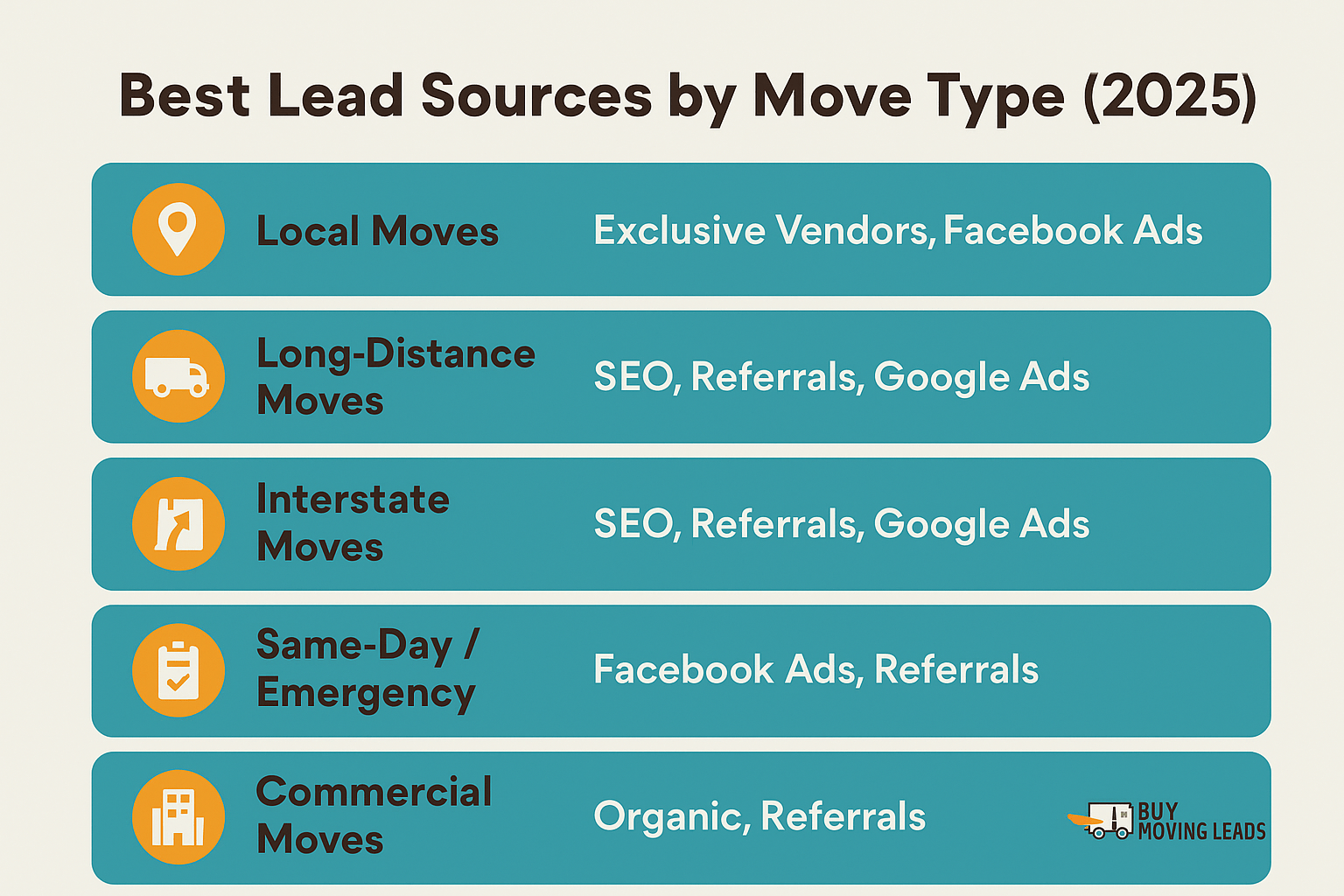
Different lead sources perform better depending on the type of move. In 2025, local move campaigns benefit most from exclusive vendor and Facebook leads, while long-distance and interstate relocations convert best through SEO, Google Ads, and referral channels.
Best Lead Sources by Move Type (2025)
| Move Type | Top-Performing Sources | Notes |
|---|---|---|
| Local Moves | Exclusive Vendors, Facebook Ads | Better targeting by ZIP code and lower CPL |
| Long-Distance Moves | SEO, Referrals, Google Ads | High-intent searchers and warm introductions |
| Interstate Moves | SEO, Referrals, Google Ads | Cost-sensitive shoppers comparing multiple vendors |
| Same-Day / Emergency | Facebook Ads, Referrals | Urgency-based decisions work well with social reach |
| Commercial Moves | Organic, Referrals | Higher budgets, more trust required |
A 2025 study by the U.S. Census Bureau confirms that long-distance and out-of-state relocations are rebounding after a dip during the pandemic, reshaping marketing strategies for national carriers.
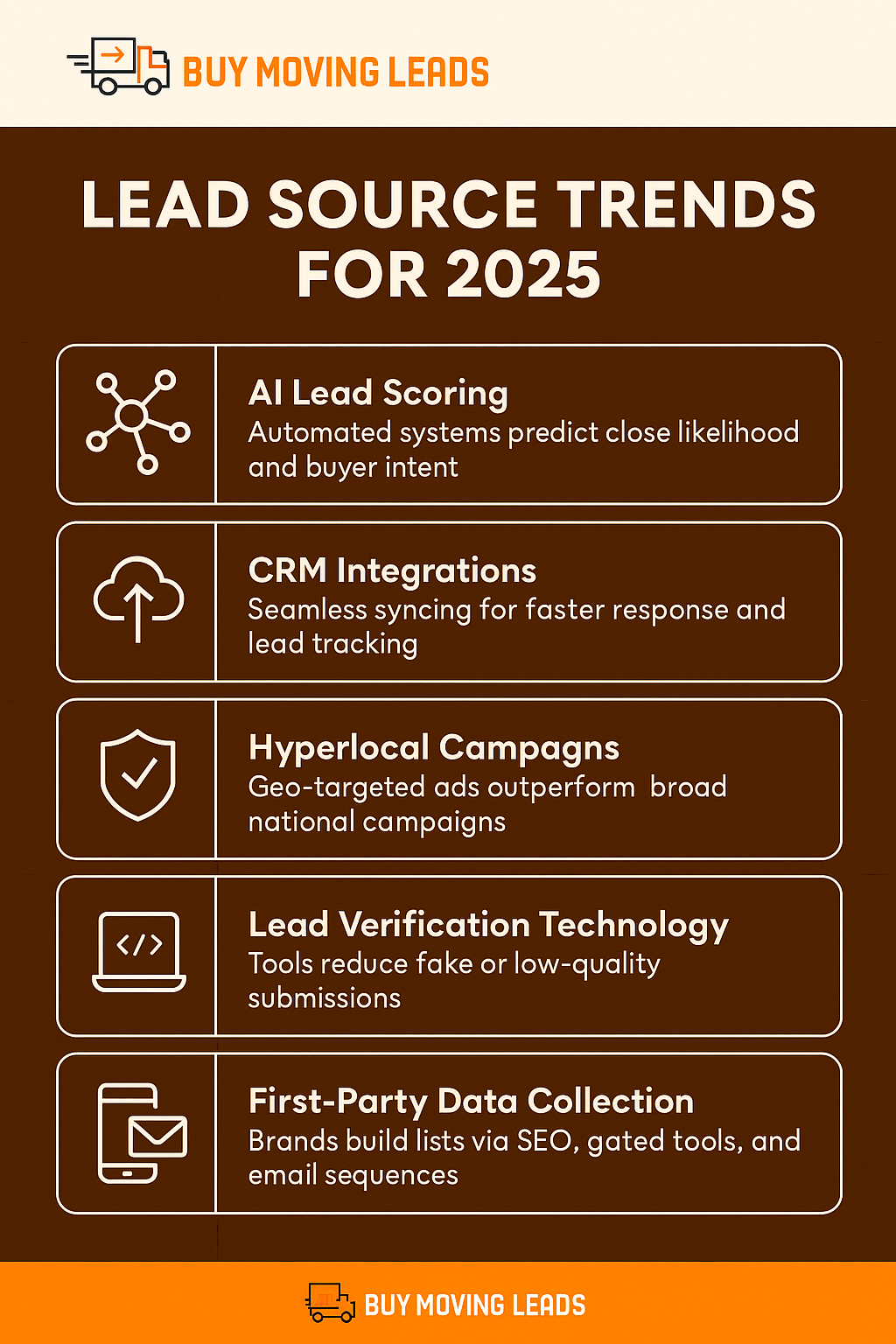
Lead Source Trends for 2025
Lead generation for movers is evolving rapidly. In 2025, automation, AI scoring, and hyperlocal targeting are reshaping how companies acquire customers. There’s also a shift away from saturated shared leads toward inbound strategies, which offer better lifetime value and lower refund risk.
Emerging Trends in Moving Lead Generation
| Trend | Description |
|---|---|
| AI Lead Scoring | Automated systems predict close likelihood and buyer intent |
| CRM Integrations | Seamless syncing for faster response and lead tracking |
| Hyperlocal Campaigns | Geo-targeted ads outperform broad national campaigns |
| Lead Verification Technology | Tools reduce fake or low-quality submissions |
| First-Party Data Collection | Brands build lists via SEO, gated tools, and email sequences |
| Automation for Follow-Ups | SMS, email, and IVR used to re-engage warm leads |
According to the U.S. Small Business Administration, the use of automation and CRM in small businesses has nearly doubled over the past five years, highlighting the growing importance of these tools in competitive markets like moving services.
Strategic Takeaways
As the moving industry becomes more competitive and lead costs continue to rise, understanding where to invest is no longer optional. The difference between a profitable campaign and a wasted budget often comes down to lead source, conversion rates, and speed to contact.
The 2025 data reveals that while referrals and organic strategies remain the most efficient, paid platforms like Google Ads and Facebook can still be effective, provided they are paired with prompt follow-ups and precise targeting. Moving companies that leverage CRM automation, AI scoring, and high-quality exclusive leads are already outperforming their competitors, who cling to outdated shared models.
To stay ahead, movers must adopt a data-first approach to lead generation, focusing on ROI, quality, and customer intent, rather than just volume.